
Media literacy must become democracy’s defence against misinformation – Shamima Muslim
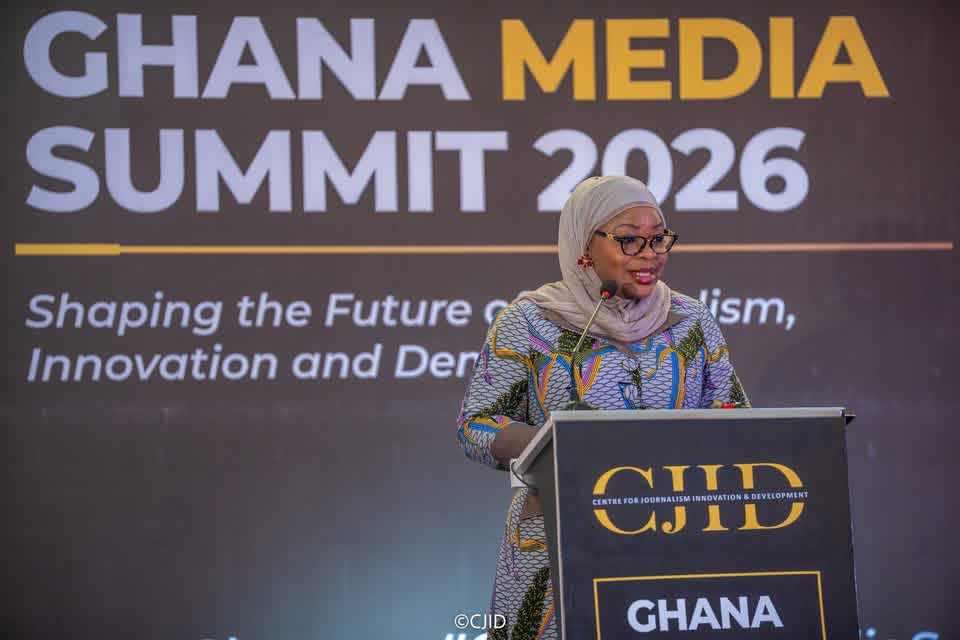
Madam Shamima Muslim, Deputy Presidential Spokesperson, has called for greater investment in media literacy, describing it as democracy’s first line of defence and a critical tool against misinformation and disinformation.
Delivering a speech on behalf of Mr. Felix Kwakye Ofosu, Minister of State for Government Communications and Presidential Spokesperson, at the Ghana Media Summit in Accra, Madam Muslim said the growing threat of false information, especially through digital platforms and artificial intelligence (AI), required citizens to develop the ability to access, analyse, verify and responsibly use information.
The summit, organised by the Centre for Journalism Innovation and Development (CJID) through its flagship fact-checking and media integrity initiative, DUBAWA Ghana, was held on the theme: “Defending Democracy in West Africa – The Role of Media.”
The event marked seven years of CJID’s contribution to strengthening information integrity, combating misinformation and disinformation, and supporting conditions necessary for a free and functional press in Ghana.
It brought together veteran journalists, editors, civil society leaders, academics, media development practitioners and policymakers to discuss strategic priorities for media development in Ghana and West Africa.
Madam Muslim said while previous generations confronted threats such as colonialism, military rule, authoritarianism and censorship, the current generation faced a different challenge where democracy was increasingly contested across digital platforms, artificial intelligence systems and social media networks.
“What is this new battlefield of democracy we speak about?” she asked, noting that information could now travel faster than verification.
She said misinformation and disinformation had become serious threats capable of undermining public trust, polarising societies and weakening democratic institutions.
She referenced global concerns about the information environment, noting that misinformation and disinformation had been identified among the major global risks, while advances in generative AI had enabled the rapid creation of convincing text, audio, images and videos.
“These are not merely technological developments, they are democratic warning signs,” Madam Muslim said, urging all and sundry to defend truth, protect public trust and ensure that facts, rather than falsehoods, shaped the future of democracies.
She said media literacy was no longer an optional educational programme but a democratic imperative and national security priority.
“In today’s digital world, every smartphone has become a printing press, every social media account a broadcasting station, and every citizen a consumer and publisher of information,” she said.
Madam Muslim said citizens who could question, verify and think critically were less likely to become victims or vehicles of falsehood, stressing that investments in media literacy were investments in democracy itself.
She said government continued to build partnerships aimed at improving citizens’ capacity to navigate the information environment responsibly.
She further described journalism as “democratic infrastructure,” saying the media sustained democracy by empowering citizens, giving voice to the voiceless, exposing corruption, challenging abuse of power, explaining complex national issues and providing credible information for decision-making.
According to her, the credibility of journalism in the current media environment would not be measured by who published first, but by who earned and sustained public trust.
She urged journalists and media institutions to continuously develop skills in digital verification, data journalism, cybersecurity, open-source intelligence and cross-border investigations.
Madam Muslim also said information integrity had become a national security issue, explaining that false information could influence elections, incite violence, weaken public health efforts, damage businesses, divide communities and undermine confidence in the state without a single bullet being fired.
She said government’s responsibility was not to censor information but to strengthen institutions through transparency, rotection of press freedoms and measures that build public trust.
Mr. George Sarpong, Executive Secretary of the National Media Commission, who delivered the keynote address on “Defending Democracy in the Age of Disinformation,” supported the call for stronger information systems, warning that democratic progress in West Africa faced growing pressures.
He said persistent corruption, economic hardship, unemployment, inequality, weakening institutions, declining trust in elections and restrictions on civil liberties had contributed to democratic decline in parts of the region.
Mr. Sarpong said the rapid spread of disinformation and political propaganda had further polarised societies, distorted public debate and weakened citizens’ ability to make informed democratic choices.
He called for investment in media literacy, civic education and fact-checking to strengthen democratic resilience.
Source: GNA