
Footbridges ignored, lives risked: Deadly habits on highways
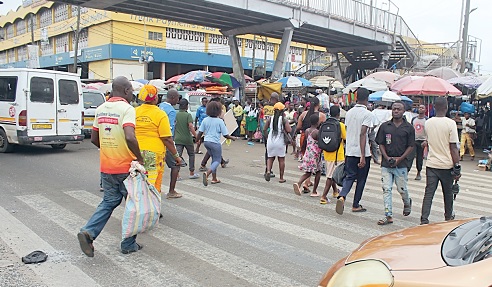 On a busy day along the Axim Road in Takoradi, cars blur past the Accra Station at top speed. Just a few metres away from the Accra Station, a pedestrian footbridge stands tall and silent, almost abandoned.
Beneath the bridge, however, is a different story. A young man darts across the road, manoeuvring between moving vehicles, with others following and timing their steps with the rhythm of traffic.
Above them is the pedestrian footbridge bridge, a vital infrastructure built to save lives but remains largely underutilised by the public.
Pedestrian footbridges serve as safe passageways over busy highways and protect pedestrians from the dangers of crossing these roads where vehicles travel at top speeds.
Samuel Coomson, a schoolboy, told the Ghana News Agency (GNA) that: “We are always in a hurry, and it is faster to cross the road this way than to climb this long bridge. Besides, it is what most people do.”
This raises a serious question about pedestrians’ regard for safety on the roads.
The paradox of Ghana’s highways
The problem is not peculiar to Takoradi. Across most parts of Ghana’s urban areas, infrastructure such as footbridges and zebra crossings designed for safety are rejected in practice.
Pedestrian deaths, largely from unsafe crossing behaviours on the roads, remain one of the most pressing yet underreported road safety issues in Ghana.
Data from the National Road Safety Authority (NRSA) show that a total of 2,312 pedestrian knockdowns were recorded between January and November last year, representing a 4.7 per cent increase of 2,208 within the same period in 2024.
In the Western Region, however, pedestrian knockdowns were reduced by 3.10 per cent from 133 in 2024 to 129 in 2025.
According to the report, pedestrians continued to remain highly vulnerable in the region, with 66.67 per cent, and 33.33 per cent of injury and fatality probabilities recorded respectively, through knockdowns.
Research indicates that up to 98 per cent of pedestrian collisions happen away from designated zebra crossing points, including footbridges.
Mr Martin Ayekeh, a road safety advocate, said: “The statistics on pedestrian knockdowns are quite alarming. This trend of citizens ignoring footbridges designed to ensure their safety and decide to cross busy highways for convenience and impatience is something that is very disturbing.”
Mr Victor Kojo Bilson, the Western Regional Head of the NRSA, told the GNA in an interview that: “We have noticed that it is not only school children, but we also find adults trying to compete with speeding vehicles to cross from one end to the other.
“As you can see, this is a three-lane highway which makes it difficult for someone to outrun a speeding vehicle.”
Why people don’t use footbridges
The refusal of people using footbridges appears to be a complex mix of human behaviour, urban design flaws and daily survival pressures.
Experts say more pedestrians choose informal crossings over nearby footbridges, and that about one in four pedestrians ignore approved crossing routes.
Some of the reasons
Convenience over safety: Many pedestrians say climbing a bridge takes too much time and energy, especially during rush hours.
Poor placement: Some bridges are located far from where people actually need to cross.
Perceived safety risks: Poor lighting, fear of robbery and isolation discourage use, especially at night.
Urban realities: Traders often occupy walkways and bridge entrances, making access difficult.
Mr Ayekeh said: “What is more revealing is the mindset behind it, and many do not even consider their safety and see nothing wrong with this risk.”
Drivers on the edge
For drivers, the unpredictability of pedestrian crossings adds another layer of danger of crashes on the roads.
Mr Patrick Somiah, Secretary, Takoradi-Accra Station Branch of the Ghana Private Road Transport Union (GPRTU), expressed worry over the issue, saying; “The bridge is there, but they won’t climb, and stand there and wait, then suddenly run to cross.
“Sometimes you slow down for them, but the car behind you is speeding, and that is how accidents happen.”
He called on the NRSA, the Motor Transport and Traffic Department (MTTD) of the Ghana Police Service, and other relevant agencies to collaborate and deepen public awareness on the use of pedestrian footbridges to help curb the phenomenon.
What the law says
Refusal to use pedestrian footbridge for any reason is a form of jaywalking on the road, and the law strictly frowns upon that.
The Road Traffic Regulations, 2012 (L. I. 2180) makes it a criminal offense for anybody to attempt to cross where a footbridge is provided, with a punishment of at least, one to seven days imprisonment or a fine.
It means that the law makes it mandatory for pedestrians to use footbridges provided at designated sections of highways to prevent knockdowns and road crashes.
Mr Ayekeh stated that despite the law making it clear that jaywalking was a punishable offense, the enforcement was lacking.
He, in that regard, urged stakeholders to ensure strict enforcement of these laws by prosecuting offenders to serve as a deterrent to others.
Breaking the habit
Changing this pattern requires more than warnings or enforcement but also understanding why the shortcut exists in the first place.
Some experts argue that the issue is not just about building bridges, but designing roads around people, noting that when footbridges are inconvenient, inaccessible, or disconnected from daily movement patterns, pedestrians will simply ignore them.
The Western Regional Head of the NRSA said the Authority had been engaging in regular visibility and enforcement drives around the footbridge as a way of encouraging the use of the infrastructure among the people.
Mr Bilson reiterated the need for the public to obey safety rules on the use of the footbridges and zebra crossing, saying; “They need to understand that the footbridge is here not for fun, but for every pedestrian to be able to cross from one end to the other safely, so they should all adhere to the usage of the footbridge.”
He further urged city authorities to deploy city guards to footbridges and designated crossing points to help deal with those who flouted the law on jaywalking.
Some recommendations
Footbridges must be placed where people naturally cross, not where planners assume they should.
There must be improvement in the design and accessibility of footbridges, because in some cases elderly people, pregnant women, children, and persons with disabilities often struggle with steep stairs, making bridges difficult to use.
Authorities should build barriers and fencing around footbridges and ensure stricter enforcement mechanisms to reduce unsafe crossings.
Stakeholders need to deepen public awareness efforts through relatable campaigns using mass media, community outreach, and educational programmes in schools. This will educate pedestrians on the dangers of jaywalking and the importance of using footbridges and zebra crossings for their own safety.
In conclusion, the question is not whether footbridges save lives, because they actually do.
As a pedestrian, choosing the shortest path by unsafely crossing through speeding vehicles is often the most dangerous, and continues to kill.
While governments continue to invest in road infrastructure, it is important for pedestrians and other road users alike to take responsibility for their safety by making the right decisions when on the road.
By Emmanuel Gamson
Source: GNA
Have the agencies considered underpasses? Maybe they would flood too easily I am not sure but the present pedestrian bridges are ridiculously long and sited in the wrong places. I think that both all road users and pedestrians need to be educated to use pedestrian crossings but, these must be clearly marked, painted, and controlled by traffic lights with severe penalties for any road user ignoring the traffic lights. Also the premise that vehicles have right of way needs to be removed and clearly and strongly replaced with ‘pedestrians always have right of way.’ This needs to be rigourously enforced.