
Colvin, Baker and Rustin: The tall trees who can inspire us
Dr. Martin Luther King Jr. made enormous contributions to our country and humanity in his 39 years on the planet, but commemorations of his life and legacy portray him far too often as a solitary figure.
Annual events frequently focus more on King’s iconic “I have a dream” speech during the 1963 March on Washington than on the more than 200,000 people who traveled from across the country to join the other speakers and him. The remarkable work Bayard Rustin did in spearheading the march’s logistics and program in less than three months draws scant attention, too. (More on him later.)
The memorial statue of King in West Potomac Park near the Washington Mall and in a line with the Jefferson and Lincoln memorials similarly depicts him as a heroic figure.
Called “Stone of Hope”, the 30-foot granite statue is the memorial’s central figure. Arms folded and holding papers, he stands resolute, towering above passerby as he emerges from the unfinished stone.
A crescent-shaped 450-foot “Inscription Wall”, also carved out of granite, contains 14 of King’s quotes. They begin with the 1955 Montgomery bus boycott and end with his final sermon, delivered less than a week before his assassination on April 4,1968.
Powerful and inspiring, the stone and quote wall convey the collective impression and subtle message that King was the primary, if not sole, force behind the movement.
But a deeper look at the history of the civil rights movement reveals the value of highlighting those people who also made substantial contributions yet have received far less recognition than King. Far from operating on his own, King was what acclaimed scholar Clayborne Carson called a ”leader who stood out in a forest of tall trees.” Shifting the kaleidoscope of how we understand King allows us to learn from the many others who played an integral role in his successes and who, through their struggles, shed light on both the movement’s limitations and the oppression they encountered from the larger society.
Claudette Colvin sitting down for justice
Claudette Colvin, who died on January 13 at age 86, was one of these.
Nine months before Rosa Parks sparked the Montgomery Bus Boycott by refusing to move to the back of a segregated bus, the 15-year-old took the same action. “I could not move, because history had me glued to the seat,” she said on Democracy Now in 2013. “It felt like Sojourner Truth’s hands were pushing me down on one shoulder and Harriet Tubman’s hands were pushing me down on another shoulder, and I could not move.”
But when Colvin became pregnant, E.D. Nixon, the former head of Montgomery’s NAACP chapter, decided she would not be an ideal plaintiff in a case against the segregation law, according to Olivia Waxman in Time Magazine.
Colvin kept fighting for justice. She was one of four plaintiffs in Browder v. Gayle, a landmark federal lawsuit filed by civil rights attorney Fred Gray, who said she gave the movement moral courage. Their testimony was a critical element of the case. In 1956, a federal court ruled bus segregation to be unconstitutional. The U.S. Supreme Court later upheld that decision.
Colvin later moved to New York and worked as a nurse’s aide, according to NPR. Although her contributions were not recognized for decades, she continued to persist in fighting for her beliefs. In 2021, she got her juvenile arrest record expunged.
“When it comes to justice, there is no easy way to get it,” she said, according to her foundation’s website. “You can’t sugarcoat it. You have to take a stand and say, ‘This is not right.’”
Ella Baker’s radical democratic vision
Ella Baker took hard stands for close to half a century.
She first became involved in the movement in the 1930s with the Young Negroes’ Cooperative League. She continued her fierce commitment in the 1940s as a field secretary for the National Association for the Advancement of Colored People (NAACP) and in the 1950s, when she worked as the first staff person and interim executive director for the Southern Christian Leadership Conference (SCLC). In the 1970s and 1980s, Baker fought for Puerto Rican independence and Angela Davis’s release and against the brutality of South Africa’s apartheid regime.
Baker also spoke out against the male dominated and patriarchal structures of the SCLC, advocating a more grassroots and collective approach. “Strong people don’t need strong leaders,” she was fond of saying.
She helped nurture the future leaders, playing a pivotal role during the end of her time at SCLC in supporting the students who protested segregation by conducting sit-ins throughout the South. She convinced SCLC to sponsor a meeting for young leaders in the South and organized a conference at Shaw University where she encouraged the students to devise their own plan of action and form their own organization. In October 1960 this organization became the Student Nonviolent Coordinating Committee (SNCC).
Although Baker never held an official position within SNCC, she gave the organization critical support and remained a trusted mentor throughout its existence.
“She gave you the energy to push,” said John Lewis, SNCC co-founder and chairman from 1963 to 1966. “You can lead. You can be somebody. You can do something.”
Bayard Rustin, the movement’s lost prophet
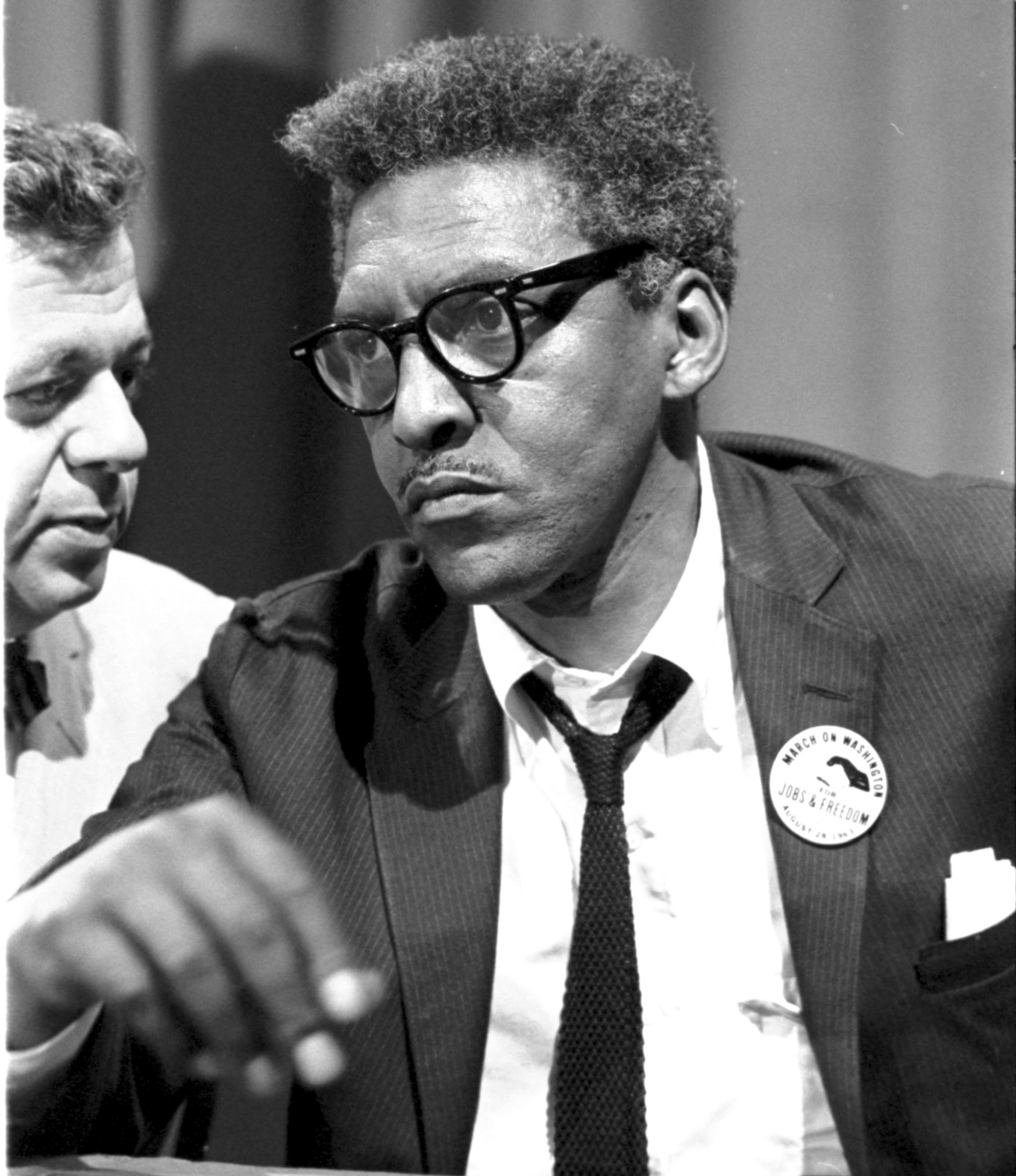
Bayard Rustin mentored King for years, but often operated behind the scenes because of his status as a gay man and the state of the nation’s homophobia.
He had two decades of experience working in social justice before King and he first connected during the bus boycott. Rustin had been a member of the Communist Youth League, worked for pacifist A.J. Muste’s Fellowship of Reconciliation, and became a pioneer in the movement to desegregate interstate bus travel in 1942.
That same year he worked with James Farmer and others to form the Congress of Racial Equality, a pacifist organization based on the teaching of Mohandas Gandhi.
Rustin played an influential role during the boycott in helping King come to a deeper understanding of nonviolent philosophy and practice, according to The Martin Luther King, Jr. Research and Education Institute at Stanford UniversityThe pair also helped organize and form the Southern Christian Leadership Conference. As King’s special assistant, Rustin assumed a variety of roles, including proofreader, ghostwriter, philosophy teacher, and nonviolence strategist, the institute said.
King praised Rustin to a colleague in 1960, writing that, “We are thoroughly committed to the method of nonviolence in our struggle and we are convinced that Bayard’s expertness and commitment in this area will be of inestimable value.”
But that same year King buckled under the threat by Harlem Congressman Adam Clayton Powell to lie and say that King was involved in a homosexual affair with Rustin unless King called off plans to demonstrate at the upcoming Democratic National Convention. Although King and Powell appeared to patch up their differences relatively quickly, the incident represented a major wound for Rustin, who felt betrayed by his mentee.
Yet when veteran organizer and Rustin’s mentor A. Philip Randolph proposed a March on Washington in 1963, Rustin sprang into action in conceiving and executing the logistics of what became one of King’s signature moments.
He did so under continued pressure due to his homosexuality. Dixiecrat Senator Strom Thurmond of South Carolina tried to derail the march by accusing Rustin of being a Communist and a pervert. His attempt failed as this time civil rights leaders backed Rustin. The march took place in August and King rode one of his signature moments into American and world history.
We mark another historic moment today, the one-year anniversary since Donald Trump returned to the presidency of the United States of America. As we contend with how to deal with the havoc he and his administration have wreaked on our democracy and the planet, we will do well not just to remember Dr. King, but other tall trees like Colvin, Baker and Rustin. All three grappled with movement obstacles and external oppression yet drew on their inner resources to meet the challenges of their times and set an example for us to follow in the same way that Colvin remembered the bravery of nineteen-century women like Harriet Tubman and Sojourner Truth.
By Jeff Kelly Lowenstein
The author is the founder and executive director of the Center for Collaborative Investigative Journalism (CCIJ) and an associate professor of journalism at Grand Valley State University.